

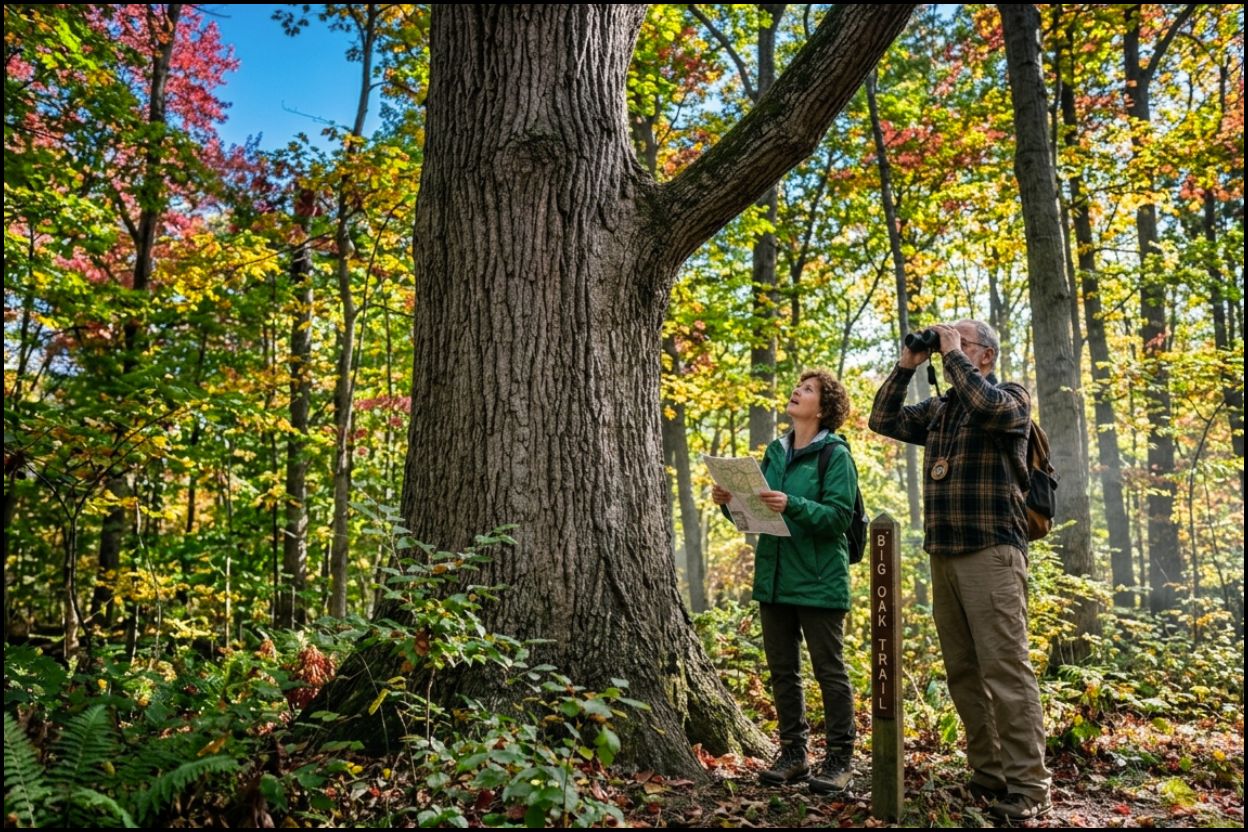
Have you ever walked through a quiet neighborhood and suddenly realized that the tree beside you is older than the houses, the roads, and maybe even the town itself? That’s exactly the kind of surprise waiting in Lewis Center, Ohio.
When people hear the phrase “Ohio Champion Trees Lewis Center Ohio,” they usually imagine some official forest or protected reserve. But the truth is more interesting. These champion trees are often standing right in suburban backyards, school grounds, and local parks—quietly growing for centuries while the world around them changes.
In this article, we’ll explore what makes these trees so special, where they come from, why Lewis Center is such a hotspot for them, and how they’ve managed to survive in the middle of modern development.
What Are Ohio Champion Trees in Lewis Center, Ohio?
To understand the importance of these trees, we first need to break down what a “ohio champion trees lewis center ohio” actually means. In Ohio, a champion tree is not just a big or old tree. It is officially recognized as the largest known example of its species in the state, based on a scientific scoring system.
That score is calculated using three key measurements:
- Trunk circumference
- Total tree height
- Average crown spread
These numbers are combined to create a final score that determines whether a tree qualifies as a champion. This method is used by forestry experts and conservation programs across Ohio.
In Lewis Center, these trees are not just isolated forest giants. They are part of a suburban landscape where development and nature intersect. Some are officially recorded, while others are “hidden champions” that have never been formally measured but clearly meet or exceed champion size standards.
Interestingly, many Lewis Center trees are not only large but also historically significant. Some are estimated to be over 150–200 years old, meaning they were growing long before modern roads and housing developments existed.
Why Lewis Center Has So Many Champion Trees
ohio champion trees lewis center ohio isn’t random when it comes to giant trees. There are real environmental and historical reasons why this area produces so many impressive specimens.
Rich Soil and Perfect Growing Conditions
One of the biggest advantages Lewis Center has is its soil. The region sits on glacially deposited soils, which are deep, nutrient-rich, and well-draining.
These conditions allow tree roots to grow deep and strong, supporting massive trunk and canopy development over time. In simple terms, trees here don’t just survive—they thrive.
Because of this, species like oak, maple, sycamore, and cottonwood can reach extreme sizes compared to other regions.
Open Agricultural History
Before suburban development, much of Lewis Center was farmland. That matters more than people think.
Trees growing in open fields or along farm boundaries tend to develop:
- Wider trunks
- Larger branch spread
- Stronger structural growth
Unlike forest trees that compete for sunlight and space, these “open-grown” trees expand freely in all directions. That’s one of the main reasons many champion trees in Lewis Center have unusually wide crowns.
Suburban Preservation Efforts
Another key reason is timing. Most of ohio champion trees lewis center ohio major development happened relatively recently. By that time, environmental awareness and tree preservation practices were already part of planning discussions.
Instead of removing every mature tree, developers often designed neighborhoods around them. Schools, parks, and roads were sometimes adjusted just to preserve a single large oak or sycamore.
This combination of modern planning and natural history is a big reason champion trees still exist here today.
Where to Find Champion Trees in Lewis Center, Ohio
If you’re hoping to see these giants in person, you don’t need to hike deep into wilderness. Many are located in public or semi-public spaces.
Alum Creek State Park Area
One of the most important regions for champion-scale trees near Lewis Center is Alum Creek State Park. This area contains large hardwood forests and riparian zones where trees have grown undisturbed for decades.
Here, you’ll find:
- Massive sycamores near water edges
- Tall cottonwoods in floodplain areas
- Ancient oak stands hidden in forest patches
These conditions create ideal environments for record-sized trees.
Highbanks Metro Park Region
Another major hotspot is Highbanks Metro Park, which is known for its scenic cliffs and forested ravines.
While not all trees here are official champions, many are “champion candidates.” The park is especially known for:
- Old-growth sycamore remnants
- Tall tulip poplars
- Mature oak forests along river bends
Some trees in this area are believed to be several centuries old, making them ecologically and historically valuable.
Residential and School Areas
One of the most surprising things about Lewis Center champion trees is that many are found in everyday places:
- Front yards
- School campuses
- Subdivision parks
- Church grounds
These trees often go unnoticed because they blend into daily life. But some of them are large enough to compete with state-record trees if officially measured.
That’s what makes Lewis Center so unique—you don’t always need to “go into nature” to find natural giants.
The Most Common Champion Tree Species in Lewis Center
Not every tree species can grow to champion size. In Lewis Center, a few species dominate the list due to their biology and environmental compatibility.
White Oak – The Silent Giant
The white oak is one of Ohio’s most iconic trees. It grows slowly but steadily, often living for hundreds of years.
In Lewis Center, white oaks are among the most likely species to reach champion status because:
- They live extremely long lives
- They develop massive trunks over time
- They adapt well to local soil conditions
Many of the region’s most impressive trees belong to this category.
Eastern Sycamore – The River Giant
Sycamores are some of the largest hardwood trees in North America. In Lewis Center, they often grow near water sources, where they can access constant moisture.
These trees are known for:
- Huge trunk diameters
- Mottled bark patterns
- Massive canopy spread
Some sycamores near Alum Creek are considered among the largest in Ohio.
Cottonwood – The Fast Grower
Cottonwoods grow quickly compared to other species, which allows them to reach enormous sizes in a shorter time.
They are commonly found:
- Along rivers
- In floodplain areas
- Near open fields
Even though they don’t live as long as oaks, their rapid growth helps them become champion contenders.
Tulip Poplar – The Height Champion
Tulip poplars are known for their incredible height. In many parts of Ohio, they are the tallest native hardwood species.
They thrive in Lewis Center because:
- They prefer rich, well-drained soil
- They grow quickly in youth
- They can dominate forest canopies
How Champion Trees Are Measured and Verified
Champion trees are not just identified visually. There is a strict scientific process behind their classification.
Measuring the Trunk
The trunk is measured at 4.5 feet above ground. This is called “diameter at breast height” in forestry terms.
This measurement gives a clear indication of how much structural mass the tree has developed.
Measuring Height
Height is measured using tools like laser rangefinders or trigonometric calculations.
Even a difference of a few feet can change a tree’s ranking.
Measuring Crown Spread
The crown spread is the average width of the tree’s canopy. It reflects how much horizontal space the tree occupies.
Once all three measurements are collected, they are combined into a final score used to compare trees statewide.
Why These Trees Matter So Much
Champion trees in Lewis Center are not just biological wonders—they are living records of the past.
They matter because they:
- Store carbon and help fight climate change
- Provide habitat for birds and wildlife
- Offer shade and cooling effects in suburban areas
- Preserve genetic diversity of native species
- Connect modern communities to natural history
In many ways, these trees are older than the town itself. They have survived farming, construction, storms, and urban expansion.
Conservation Challenges Facing Champion Trees
Even though ohio champion trees lewis center ohio has done a good job preserving many trees, challenges still exist.
Urban Expansion
As development continues, some trees are still at risk of being removed for housing or infrastructure.
Storm Damage
Large trees are vulnerable to windstorms, ice, and lightning. Losing a major limb can reduce their champion status.
Disease and Pests
Invasive insects and tree diseases are a growing concern across Ohio forests.
Lack of Awareness
Many champion trees remain unrecognized simply because people don’t know how important they are.
Final Thoughts: A Living Legacy in Lewis Center
ohio champion trees lewis center ohio are more than just natural landmarks. They are living witnesses to centuries of environmental change, human development, and ecological resilience.
What makes them truly special is their quiet presence. You don’t need to visit a deep forest to find them—you might already be living next to one.
And maybe that’s the most powerful takeaway: sometimes the most extraordinary things in nature are hiding in plain sight, right in our neighborhoods.
